Expiration Outages
Missed expiration dates lead directly to service downtime and loss of trust.

Certificate Lifecycle Management Platform
Automate issuance, deployment, monitoring, renewal, and revocation in one platform.
Prevent certificate expiration outages and operate securely on proven standards.
Certificate inventories keep growing, while operations still depend on manual work.
One missed renewal can disrupt an entire service.
Missed expiration dates lead directly to service downtime and loss of trust.
Distributed certificates are difficult to discover and manage across the organization.
Server-by-server deployment increases configuration errors and operational burden.
Centralized ManagementInventory every certificate in one place for enterprise-wide visibility.
End-to-End AutomationConnect ACME issuance, deployment, and renewal in one pipeline.
Continuous ControlCombine TLS monitoring with policy-based approval workflows.
The real risk is not the expiration date itself. It is the break between discovery, renewal, deployment, and verification.
Card payment disruption lasting 3–4 hours following a missed SSL certificate renewal and VAN update issue.
A certificate expiration caused approximately three hours of access disruption to a global collaboration service.
An internal TLS certificate expiration disrupted login, purchases, and backend communications for 5 hours 35 minutes.
ORDIS CLM connects visibility, automation, verification, and governance to make certificate operations predictable.
Identifies certificates nearing expiration, renews them via ACME, and redeploys them to target servers.
Continuously checks TLS status and expiration dates to surface risk before it becomes an incident.
Applies policy-based approvals to critical issuance, deployment, and revocation operations.
Protects private keys and sensitive data with encryption, MFA, and role-based access control.
Prioritize expiration risk, failed jobs, and pending approvals alongside certificate status, type, and CA information.
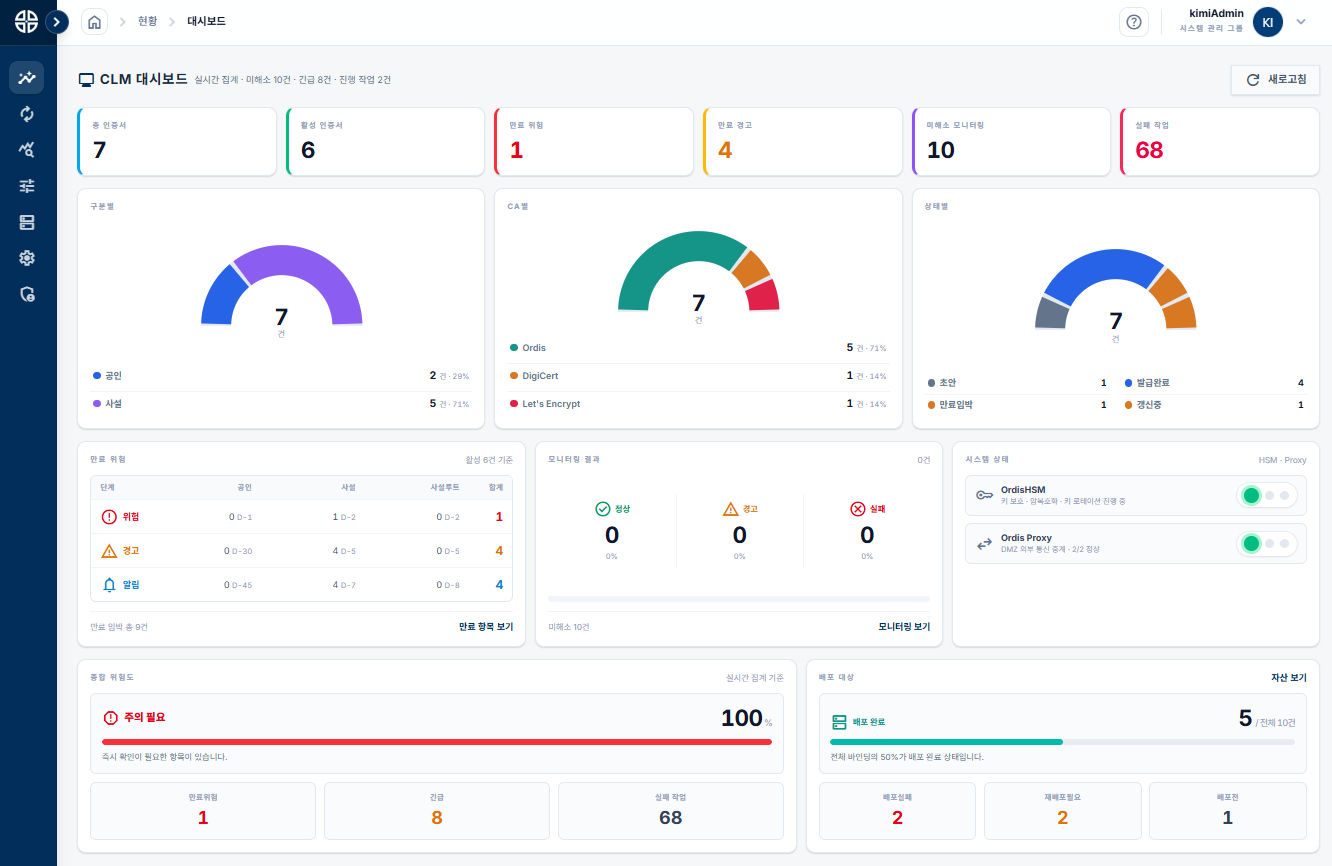
Identify expiring certificates, renew via ACME, match targets, deploy automatically, and verify TLS fingerprints without manual intervention.
New · Import
→ACME Automation
→Policy Workflow
→Auto Deployment
→Continuous Checks
→Auto Renewal
→Replace · Revoke
The scheduler handles expiration, TLS and revocation checks, renewals, deployments, approval reminders, key rotation, and recovery.
Public CA traffic is routed through OrdisProxy, while private CA and HSM traffic stays internal. CA scope policies determine each path.
Standards-based protocols and protected credentials automate certificate issuance and DNS-01 challenges.
Automated ACME (RFC 8555) issuance · EAB support
HSM issuance · Private key protection · Private certificate operations
DNS-01 automation · Encrypted credentials · Domain zone mapping
Protect certificate assets with layered controls across data, access, communications, and operations.
Protect private keys, PFX, SSH keys, and account keys
Block plaintext storage when HSM is unavailable
Exclude sensitive fields from responses
Multi-factor authentication
Role-based access control
Audit and event logs
Request signing and secure communications
Lockout-safe SSH key replacement
Automatic recovery of stuck jobs
Improve resilience, efficiency, visibility, and security by combining automation with governance.
Automated selection, renewal, and redeployment help prevent certificate-related service disruptions.
Automation reduces repetitive work, operational overhead, and human error.
See where every certificate is deployed and when it expires from one screen.
Approval workflows, granular permissions, and audit logs support compliance requirements.
HSM encryption and a DMZ proxy architecture protect private keys and communication paths.
ACME, cloud DNS integrations, and deployment adapters support diverse environments.
See how ORDIS CLM can support your certificate environment with a tailored product demonstration and consultation.